


Introduction
Nowadays, a modern refinery has a throughput of billions of US dollars per year in the gas and diesel market. However, tight oil refining margins and stringent product quality requirements make it more difficult for oil refiners to produce petroleum at low prices.
As a result, several refineries are spending a large portion of their resources on product blending. Therefore, offsite production and maintenance are of vital importance to a refinery’s economy and viability. In addition, critical changes in the control and management of offsite operations can be accomplished by automating a refinery offsite, often with less than two years’ payback.
This topic will discuss the benefits of refinery offsite operations. For example, terminal operations, material movement, tank farm management, product blending, crude blending, return on investment, benefits versus start-up time, etc.
Benefits of Automation in an Offsite Refinery
Typical offsite automated processes deliver the following advantages:
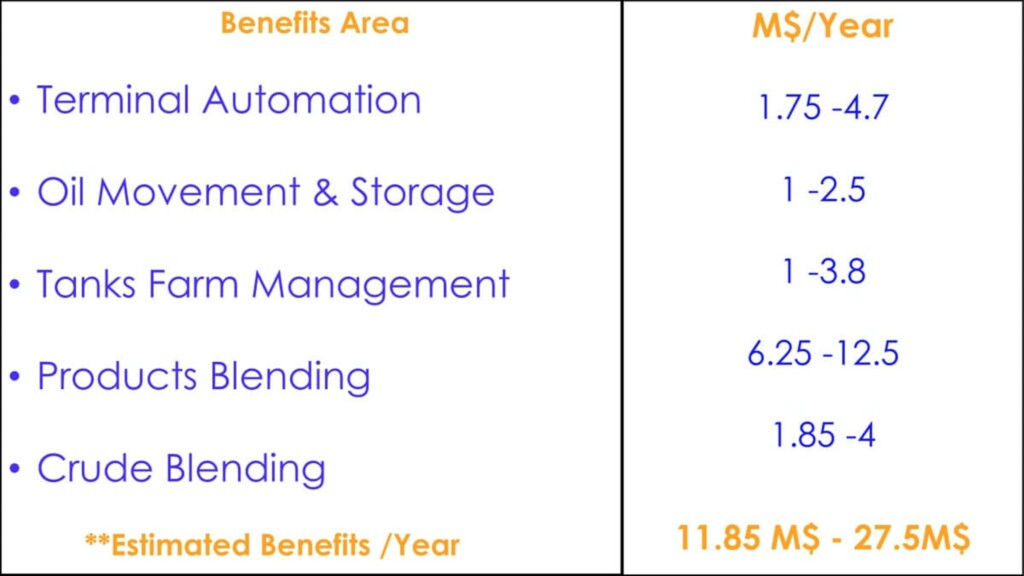
Terminal control functions for managing truck and bus and ship transportation machinery (with programmable time sheet logging for demurrage monitoring) can be included with the user interface and server layout. Considerable benefits of incorporating a terminal operating system include custody transfer, demurrage charges, opportunity gained, water management in crude, and planning and scheduling. In addition, it can result in savings of $1.5 to $4.7 million a year.
The material movement control system provides a simple and reliable method for converting business instructions into process movements. Process workers may insert and decompose orders into distinct actions either electronically or manually. Advantages of incorporating this system include minimizing loss in quality and quantity, less contamination, and decreased utility expenditure. Planning and scheduling can also help refiners save $1 to $2.5 million a year.
The tank farm management framework offers a standard approach for handling data on tank inventory and a single-window GUI for all main gauge networks. It measures, displays, and records all process parameters related to a tank. This can result in inventory reduction, automatic lineup, real-time information system, and minimization of spillage, reducing total expenses by up to $3.8 million a year.
The product blend optimization program includes configuration, testing, pre-blend refinement, and constant, efficient online regulation of the blend offline. This minimizes manufacturing prices, quality loss, and recipe variance. It also improves production, allowing a net savings of $6.25 to $12.5 million a year. Concerning its properties, a refinery is typically designed to function on a certain form of crude oil. The benefits of automation in crude blending include uniform crude feed, reduction in crude tank swing, and crude yield increase, saving $1.85 to $4 million a year.
Summary
Consistent and reliable data concerning refinery inventory is vital for efficient preparation, scheduling, and control of material losses. In addition, intelligent instrumentation to handle inventory offsite can deliver a return on investment in 1 to 2 years.
Options for eLearning This Topic
Browse Our Academy Course Catalog
#TankFarmManagement #Real-TimeInformationSystem #RefineryTerminalOperations #Single-WindowGui #RefineryProductBlending #ProductBlendOptimization #AutomationCrudeBlending #HandlingTankInventory #HandleInventoryOffsite #TankFarmGaugeNetworks #RefineryDataInventory