


Introduction
The blending process is complicated. The most critical issue is selecting the optimal combination of components to produce the desired final product. Different hydrocarbon streams are considered while blending stocks using linear and nonlinear programming. This is done to produce chemical products as per various quality specifications and maximize operating profit.
This topic will discuss the comparison of linear, indexed linear, and nonlinear blending models; examples of nonlinear models; nonlinear qualities; interactive coefficients; nonlinear blending values; reformulated gasoline blend models; pros and cons of nonlinear models; etc.
Blend Models – Nonlinear and Linear
In linear blend models, the components’ qualities are blended as per their native values. In indexed linearized blend models, component qualities are modified as per blending/index values. Then they are blended as per changed values.
In nonlinear blend models, blend quality depends on composition and component qualities. In other words, it handles all kinds of components in the blend.
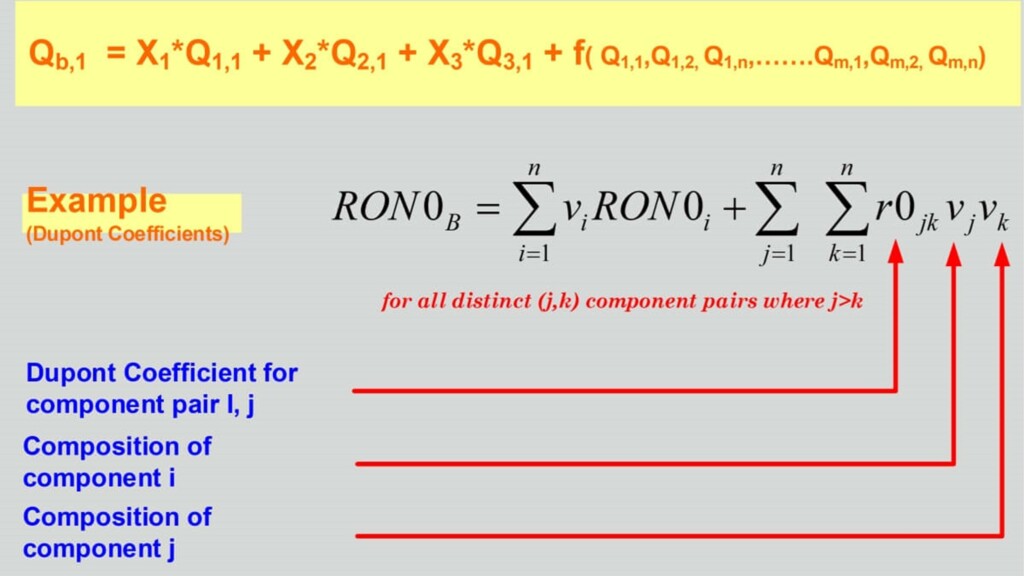
In nonlinear blend models, the component qualities are blended by their native values plus a nonlinear interaction term.
In nonlinear indexed linearized blend models, there is a linear blending of the components done as per their nonlinear blending values. Nonlinear blending quality models are the most complex. They are difficult to use in a blending of fuels. Excel or a simple calculator cannot be used easily to calculate the final blend qualities for no-linear models. Nonlinear modeling is a true representation of blending mathematics.
Blend qualities may be ‘squeezed’ to improve the bottom line.
A refiner may adjust parameters to customize nonlinear models. Non-DCS systems are needed for implementation purposes.
The use of the interaction coefficient is related to moderation. The interaction coefficient is determined by the 50/50 mixture method.
Nonlinear Blending values
These values for RON/MON depend on aromatics and olefins in addition to component octane(s). Nonlinear blending values for ASTM D-86 temperature depend on VABP and the component’s 10% and 90% pts.
The reformulated gasoline model uses a complex model to focus on the toxic, NOX and volatile organic compound (VOC) specifications. RON/MON/RDOI blend qualities blended nonlinearly, while diesel and fuel oils have no on-linearity.
Summary
For blending purposes, some qualities have to be changed to non-indexes. Only those few qualities need to be blended nonlinearly. Component properties play a significant role in the context of nonlinear quality models. For a refiner, it is difficult to use these models for the purpose of fuel blending.
Options for eLearning This Topic
Click to enroll for the eLearning of this topic on the linear and nonlinear blend models
Browse Our Academy Course Catalog
#Non-IndexedBlendingModel #NonlinearQualityModels #VocGasolineModel #Non-DcsRefinerySystems #NonlinearBlendModels #LinearBlendModels #HydrocarbonBlendingStreams #InteractiveCoefficients #IndexedLinearModel #ReformulatedGasolineBlendModels