


Introduction
Many superstructures have been presented with a general topology to implement the nonlinear processes and blending relations. The main objective is extending the model addressing a single product to multiple ones connected at the common supply pipelines. A refinery should also place and interconnect its intermediate streams to take advantage of its multiple production infrastructures.
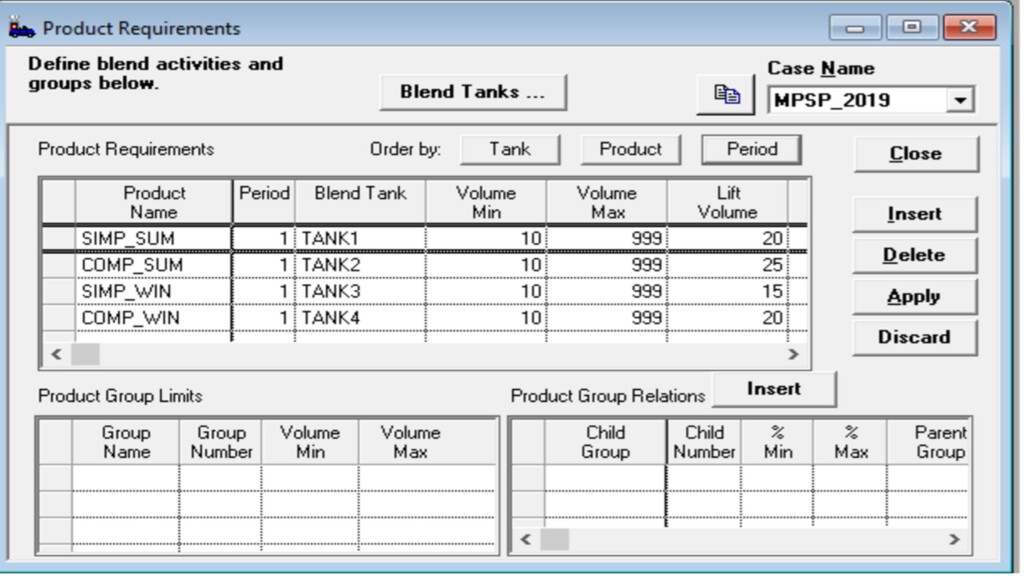
This topic will discuss optimization of summer-grade and winter-grade gasoline, simple and complex EPA RFG models, virtual blend tank concepts, single-period virtual blending, multi-blend types, blend specifications.
Data also need product requirements, stock productions, availability and allocations, simple and complex models for summer/winter specs, optimization of multi-spec gasoline grades in a single period, etc.
Different Models Adopted by Refineries
At the end of the 20th century, oil refineries were forced to omit the “simple” model and adopt a “complex” model to calculate the emissions of VOC, TAP, and NOx from the combustion of regular gasoline. The objective of this RFG (reformulated gasoline) program was to control and reduce the emission of VOC.
This program was implemented in two phases. In the first phase of the program, VOC emission had to be reduced to 15%. Phase 2 required additional emission reductions.
Both models were used during the execution of these phases. However, the models differ in the control application due to different levels of sulfur and olefin.
Simple Model
As the simple model was being proposed/ implemented, various fuel variables were considered. Unfortunately, data was appropriate for only a few variables (Reid vapor pressure, oxygen, benzene, and aromatics). Other parameters remained unquantifiable, mainly sulfur, olefin, and T90s. The EPA suggested that they could be fixed at the individual baseline point (1990 average) of the refiner, avoiding undercutting the reduction in emissions achieved by simple model parameters. The effect of aromatics on emissions also remained unknown. Still, it was expected that the number of aromatics would be regulated by their part in the emission of TAP.
Complex Model
At the start of 1998, it was made mandatory that all RFG would be certified using the complex model. Thus, all refineries would be calculating the emissions from “statutory baseline gasoline,” eliminating the usage of individual baselines of refineries.
Summary
Production management is a critical phase in controlling and maintaining the activity of a single refinery and its complexes. Therefore, for refineries, it is necessary to use the complex model.
Options for eLearning This Topic
Click to enroll for the eLearning of this topic on the multi product single period optimization
Browse Our Academy Course Catalog
#RefineryProductionManagement #RfgCertifiedRefinery #StatutoryBaselineGasoline #SimpleModelParameters #Single-PeriodVirtualBlending #RefineryModel #EmissionVocReduce #VirtualBlendTank #Winter-GradeGasoline #Summer-GradeGasoline