


Introduction
Blending methods inherit multiple sources of error during operation. These mainly are in flow calculations, blending models, values, analyzers, lab testing, and forecasts. Therefore, optimization and reconciliation of blend model parameters must be carried out to maximize profitability.
This topic will discuss identifying and estimating blending errors, error minimization, reconciliation and feedback, sources of errors, blending goals, blending infrastructure and process, etc.
Identification and Rectification of Model Errors
Most inaccuracies arise from the use of online analyzers for quality checks of component streams and blend headers. Transport lag, dead-time lag, and dynamic lag in the analyzer account for radical errors. Also, inaccuracies in quality correlation and blending process and human and flow measurement errors are common causes of inaccuracies.
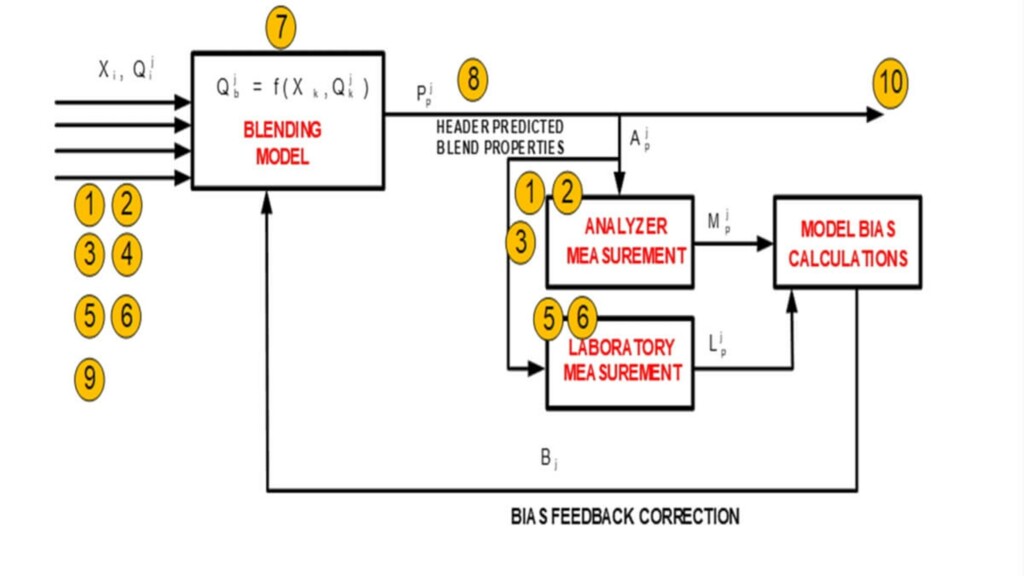
Identification of these errors is carried out by feeding these calculated errors into a blending model. It comprises a set of mathematical equations followed by analyzer measurements and laboratory measurements. Feedback correction from model bias calculations is then fed back into the primary blending model.
Correction in flow measurement is defined by an equation where corrected flow is the sum of raw flow, zero offsets (value of raw flow at zero output), and calibration correction constant.
Analyzer error is the combined result of transport lag and dynamic lag. Analyzer error is measured as the difference between actual quality value and achieved steady-state value. Common causes of these lags include calibration out, frozen signals, out-of-limit signal, violation of rate of change, bias limits, and downtime for repair. The online storage of lab analysis values and statistical history of analyzer biases, plus the use of an analyzer to check algorithms, can help minimize these errors.
In linear blend models, component qualities are blended by their indexed values. They are blended by their native values, a nonlinear interaction term, and a bias term in nonlinear models. Two-step nonlinear regression methodologies can give the best possible values by substituting parameters for each optimization step. Therefore, effective automation of blending infrastructure, installing systems to measure real-time stream qualities, and using nonlinear blend models to minimize errors are of key importance.
Summary
Fuel must be optimized by maximum use of cheaper components to make refineries profitable.
The trim blend may use components at the end of the blending process to adjust octane and RVP. Re-blends are carried out to the correct specifications of fuel for quality control.
Both result in huge costs for a refinery. Thus, minimizing inaccuracies and errors during the blending process is important. In addition, it helps to avoid trim blends and re-blends.
Options for eLearning This Topic
Browse Our Academy Course Catalog
#ReconciliationBlendModel #EstimatingBlendingErrors #PrimaryBlendingModel #BlendingCalibrationCorrection #LinearBlendModels #NonlinearModels #Real-TimeStreamQualities #TrimBlendModel #RefineryBlendingProcess #AvoidRe-BlendsRefinery