


Introduction
There is a control system for the preparation of the end products obtained by blending. First, it is prepared as per the standard recipe specifications. These recipe specifications are set in the control system. Then the DCS (distributed control system) operates the specified pumps to keep the product meeting requirements. There are different advantages and disadvantages concerning DCS. DCS properties and operations vary from vendor to vendor, but the basic concept remains the same.
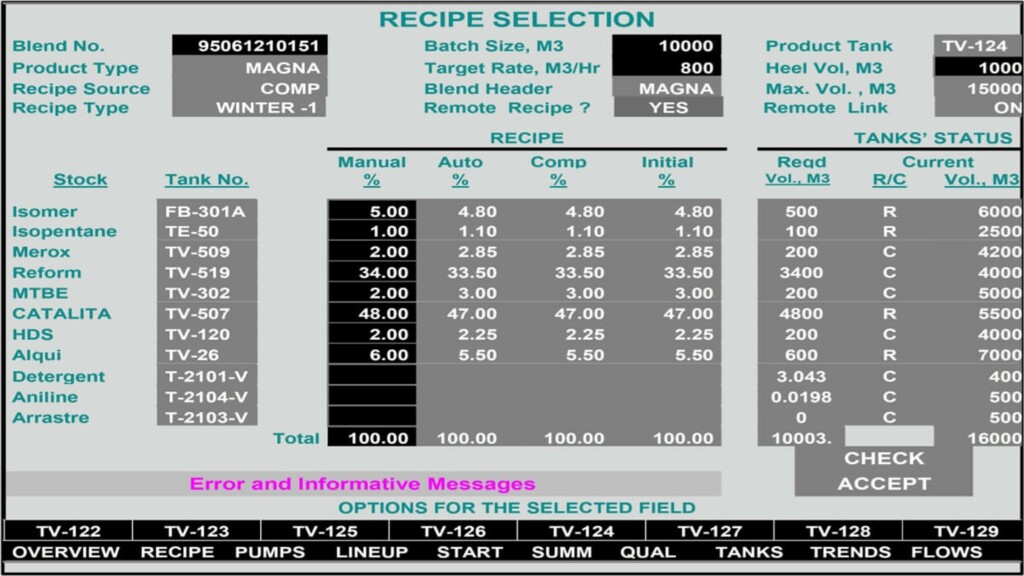
This topic will discuss DCS-based recipe control, typical/advanced functionalities, ramping, pacing, a roadmap to RBC operations, recipe selection, pumps usage history/selection.
Additionally, it discusses auto blend lineup, blend status, control, and status monitor, analyzer status, blend monitoring, the additive injection system, current blend/ final blend/screen reports, etc.
Advanced DCS system
In a refinery, there are different types of control systems for blend control. DCS is the most advanced and reliable system. An operator can select the recipe and different sources. In addition, S/he can see the history of different pumps and other details. Advanced features of the control system include multi-blend operation, total batch control, screen reports, and blend monitoring.
Ramping and Pacing
Ramping and pacing are the two major features of DCS. Ramping is the timely automatic control of pumps. This helps to manage the blending process. Initially, pumps have different flow rates. However, after a few seconds, they all are at full flow. Ramping manages this operation at the start, middle, and end of the blending process. Pacing also ensures efficient control of the blending process.
It can make automatic changes in the blending process. These changes are based on pump flow rate, input and output set points, control limits, control valves, limits, and dead bands. In the context of mathematics, there are low and high pacing limits. These limits are related to equipment.
Regulatory Blend Control
RBC (regulatory blend control) operation has the following sequence: recipe selection, auto pump selection based on the pump operation history, auto blend line up, blend configuration based on data analyzing, and blend control. The blend control is based on the blending monitor and blending reports. The DCS system controls the addition of additives as well. Blending reports at different points and at the end of the blending process are added features of DCS.
Summary
RBC is the first inline control system that has advanced features and limitations. RBC depends on DCS. Although different control systems have different functions and properties, ramping and pacing are important features of DCS. This system can work for the stored/added/planned recipe to match specifications. This system is a standalone system. It controls blend ratio, but it cannot provide inline optimization, analyzer feedback, or nonlinear blending accounts.
Options for eLearning This Topic
Click to enroll for the eLearning of this topic on regulatory blend control
Browse Our Academy Course Catalog
#RegulatoryBlendControl #ProvideInlineOptimization #StandaloneSystem #ControlsBlendRatio #DcsRamping #Multi-BlendOperation #Dcs-BasedRecipeControl #AutoBlendLineup #AdditiveInjectionSystem #PacingControlSystem