


Introduction
The appropriate design of a tank farm and its respective tank gauging system is vital for a refinery. Improving on these aspects and their automation allows a refinery to operate at its maximum efficiency. This is achieved by minimizing errors through reliable measurements, early detection, and real-time data transmission using online sensors.
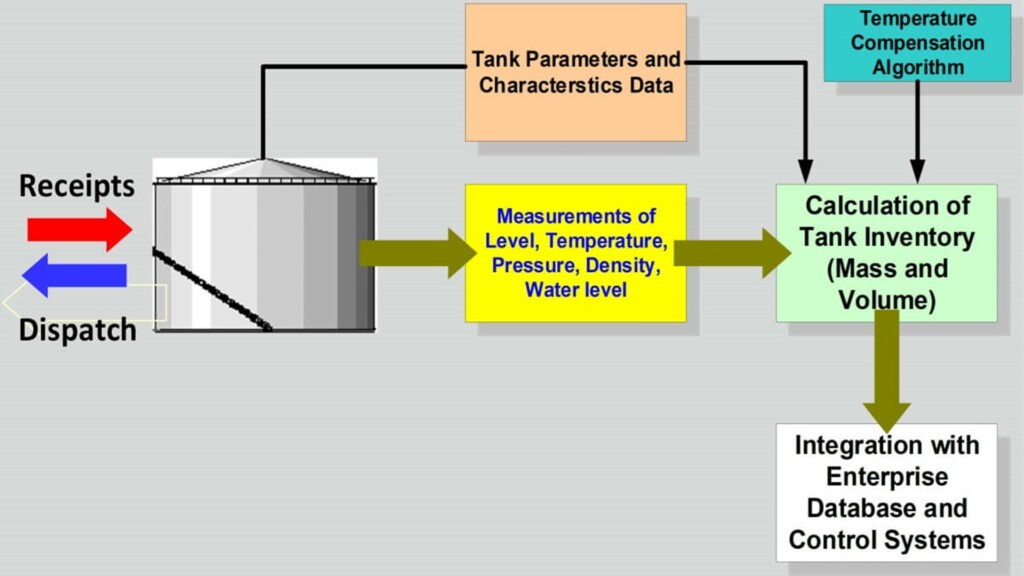
This topic will discuss the role of a tank and required information, steps to measure parameters and inventory, level sensing technologies, illustrative automatic tank gauging (ATG) system architecture, float type gauges, the reflection of a wave from the surface, hydrostatic pressure gauges, displacer type gauges, etc.
Tank Gauging System
In refinery operations, storage tanks are a major part of the process to determine blending specifications. But, first, there are mathematical calculations for tank fabrication and gauging. These calculations are conducted for the most commonly used storage containers.
Next, the risk concerning tank design and installation is reviewed. Finally, tank compliance to specifications is assessed. These specifications are standardized by associations such as the American Petroleum Institute (API), the American Society of Mechanical Engineers (ASME), and the National Fire Protection Association (NFPA).
A tank gauging system is designed to obtain information concerning overfill prevention. The system consists of independent high-level indicators or level switches. The tank gauging system is based on net standard volume (NSV) instead of level for leak detection. Tank inventory is assessed using ATG.
The ATG system ensures that the system will provide information as per programmed intervals or instantly if necessary. Tank capacity tables (TCTs) or strapping tables are prepared by measuring tank shape, roof, wall roundness, and floor profiles. ATG must follow engineering standards like those in the Manual of Petroleum Measurement Standards (MPMS) by API. Float gauges are equipped with transmitters for remote monitoring, troubleshooting float gauge problems, and recognizing error sources such as buoyancy differences, dead-band, backlash, and hysteresis.
A refinery’s need for volume and/or mass assessment is evaluated depending on its purpose. Using the frequency-modulated continuous-wave (FMCW) signal processing method, a radar gauge may deliver better instrument-level gauging accuracy. Sensors connected to the tank gauging system are utilized to determine the free water level. They also aid in having better volume readings. Vendor documents are to be assessed about the reliability of indicated accuracy versus operational performance of instruments. These instruments are related to the tank gauging system.
Summary
Tank farms and a tank gauging system play a significant role in oil movement and operations, inventory control, and mass balance. Chemicals are monitored and controlled during refinery operations, transportation, and storage using a tank gauging system.
Options for eLearning This Topic
Click to enroll for the eLearning of this topic on tank gauging system
Browse Our Academy Course Catalog
#MpmsEngineeringStandards #NfpaStandardizedAssociations #NsvLeakDetector #Instrument-LevelGauging #FmcwSignalProcessing #RadarGaugeSystem #TctStrappingTables #HydrostaticPressureGauges #TankGaugingSystem #DisplacerTypeGauges